Target Premium
Target Premium
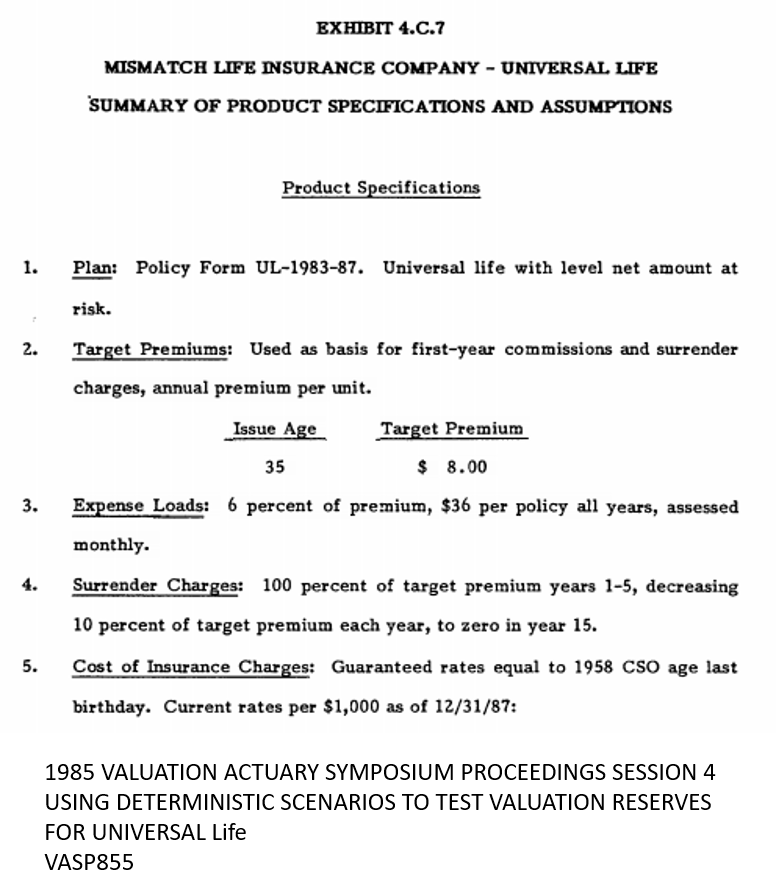
- In our Universal Life products, we need to find that critical point, or what is as important, what is the best level of premium relative to the target premium.
- You don’t want all target premiums.
- In fact, the lower the premium is, the closer to the minimum premium, the happier we are.
- How do we communicate that to our agency people?
— RICHARD SCHWARTZ, (responsible for the product marketing function for the agency distribution systems for the Sun Life Group of America)
1986 – ORGANIZING THE PRODUCT DEVELOPMENT FUNCTION, Society of Actuaries – 46p
“If your training process for your agents is to sell at target premium, for example, and target premium carries the policy to maturity at a 7 percent rate, if you’re only crediting 6, it’s not making it there. So keep an eye on how you’re training your agents to sell your products and try to avoid problems up front in the product performance before they become a premium risk problem.” MR. JOSEPH E. PAUL2001 – Investment Strategies to Maximize Yield, Society of Actuaries
Mr. Birdsall asked if the agent compensation structure for IUL products provide greater incentives for agents than is provided by the compensation structure of traditional universal life (UL) products.
Mr. Samuelson (MetLife) said that a compensation study he had previously conducted found that, on average, IUL policies have a target premium 80% higher than the average target premium for UL products.
2014 – 11/14-15/2014 LATF 6-63
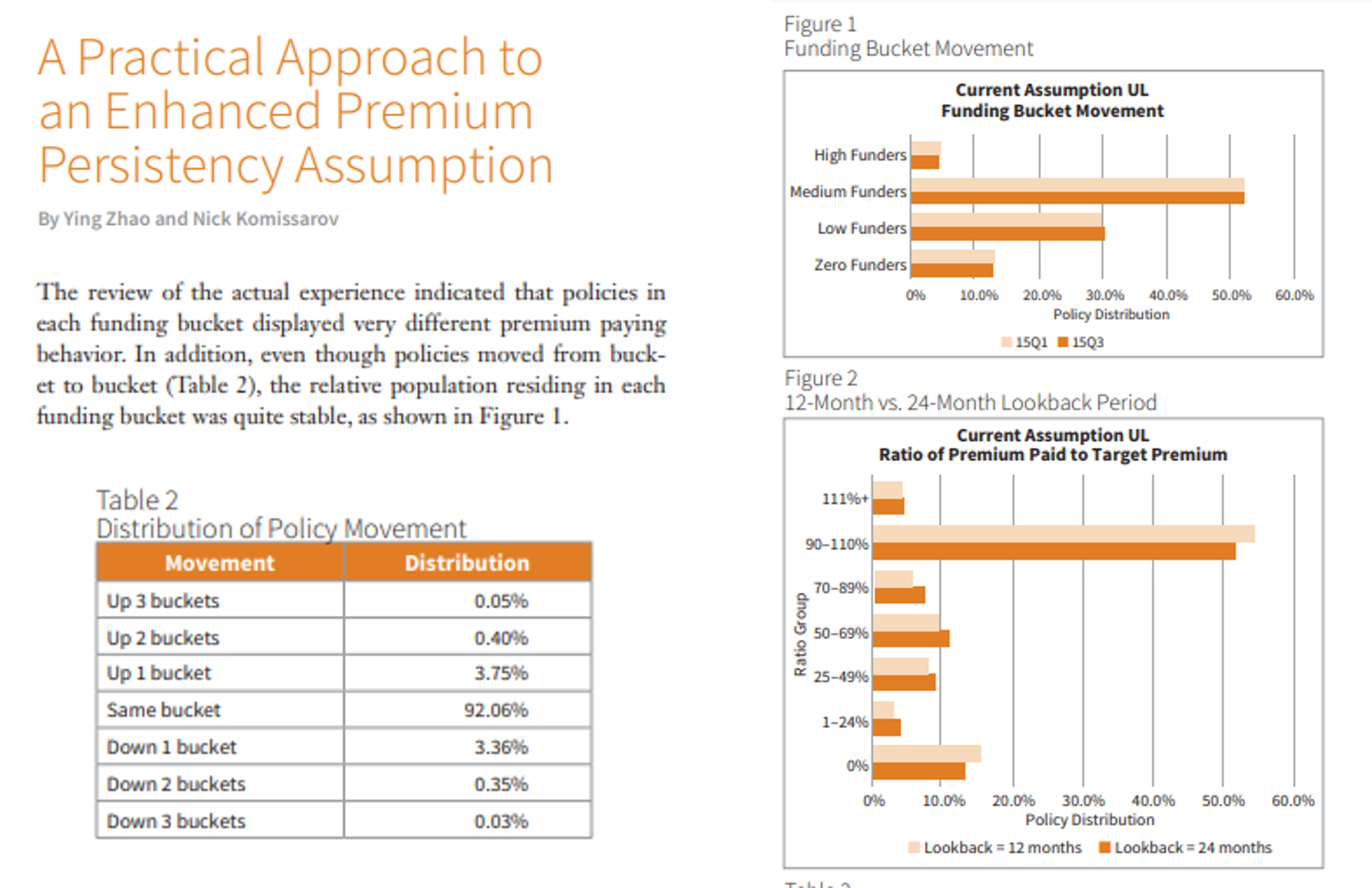
… most products have a target premium of some sort for each policy that could be and often is used as a future premium assumption.
2016, A Practical Approach to an Enhanced Premium Persistency AssumptionYing Zhao and Nick Komissarov, Society of Actuaries Thus, we have universal life policies with a so-called low target premium where excess interest earnings can carry the policy for
the whole of life with the payment of that low premium.
We have the other extreme where the premium is higher but through the use of dividends or excess interest earnings, premiums are paid for only a few years.
— JOHN L. MARCUS, Prudential
1984 – DEREGULATION OF FINANCIAL INDUSTRIES – 30p – rsa84v10n221
site_soa.org -exam _life insurance_ _target premium_ universal – Google Search
Maybe he is not getting all the disclosure he needs, as far as the continuing benefit is concerned, when the interest rates change from that illustrated.
Products which are sold with target premiums may not have had the fact considered that in any proposal based on high interest rates over long periods, more coverage will be needed.
We would be happy to illustrate the other way for the policyholder if he wants it that way, but I don’t think he knows that he wants it that way.JAMES N. PARRISH
1982, Universal Life, Society of Actuaries
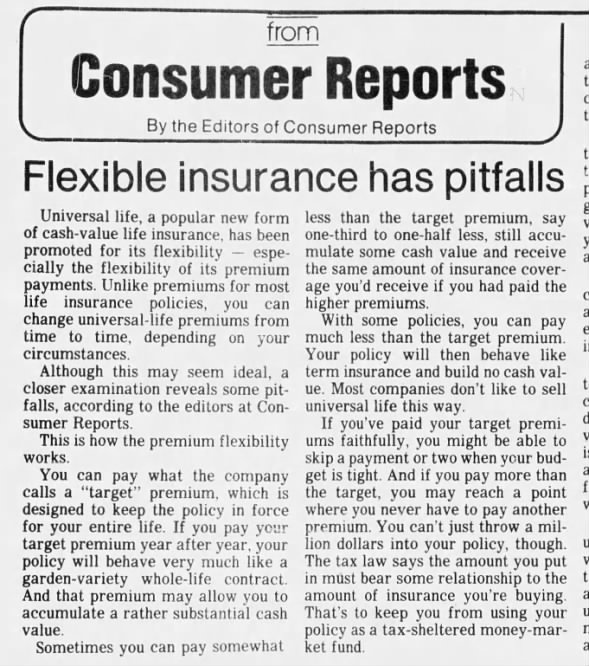
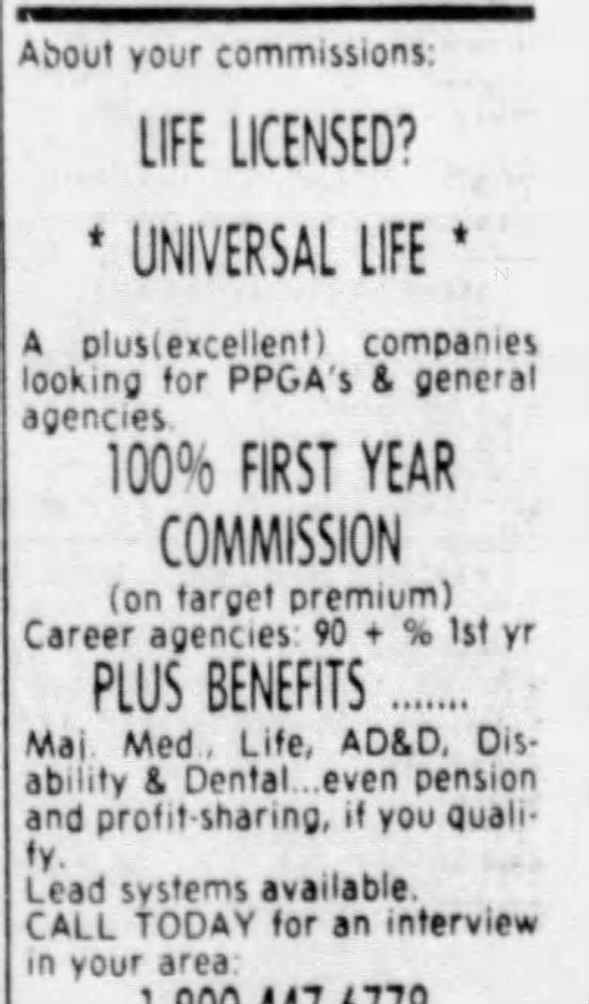
An approach which seems to be gaining in popularity expresses commissions as a percent of a target or a minimum premium.
1983 – Universal Life, Society of Actuaries – 24p
It willbe mathematically possible to calculate
a schedule of “target” periodic
premiums to be paid under the policy,
which will be intended to provide t~e
insurance benefits desired by the
policyholder at any given time. Many ·
policies may stipulate a target premium
schedule, and many companies and
agents will encourage (but not require)
purchasers to make payments in
accordance with such a schedule. The
failure to pay a target premium will not
of itself cause the policy to lapse, however.
Federal Register / Vol. 48, No. 231 / Wednesday, November 3~, 1983
Legal Case
2011 – FAIRBANKS v. FARMERS NEW WORLD LIFE INSURANCE CO-Scholar.google.comThe complaint set forth a litany of alleged facts misrepresented or concealed from policyholders, including,….. (d) Farmers encouraged setting the premium for FFUL policies no higher than a “target” rate, by its commission structure; however, policies would lapse when only the target premium was paid;
Plaintiffs also noted that Farmers’s computerized rate-setting program would inform agents of the minimum and target premiums, thus suggesting that the premium be set between these two numbers, and no higher.
Plaintiffs’ argument regarding the underfunding of the FUL policies was more direct. As Farmers set the premiums on these policies, it was solely within Farmers’s control to establish initial premiums high enough to accrue sufficient interest so that the policies would be on track to last until maturity. Farmers set the premiums based on a presumed 11.5 percent interest rate, which plaintiffs argued was unrealistically high, and would result in the policies lapsing.
As a result of the declining interest rates during the first ten years, the amount accumulated in the deposit fund after ten years is less than anticipated when the contract was issued, and less than necessary to keep the contract in force for the long term if the original “target premium” assumptions were continued.
Industry experience indicates that policyholders will increase their renewal premium payments in order to maintain their valuable insurance and minimum deposit interest rights.
For purposes of these Illustrations, we assume that the policyowner wishes to keep the UL contract in force and increases the renewal premium payments from duration ten.
Therefore, after the tenth year, an increase in the rate of premium payments into the deposit fund is illustrated sufficient to provide funds to maintain the contract in force under the changed financial conditions.|
In practice, policyholders are continually modifying their behavior to reflect changing circumstances.
2004 – Renewal Premiums and Discretionary Participation Features of a Life Insurance Contract. A Joint Research Project of the ACLI/IAA, page 88
In our universal life products, we need to find that critical point, or what is as important, what is the best level of premium relative to the target premium.
You don’t want all target premiums. In fact, the lower the premium is, the closer to the minimum premium, the happier we are. How do we communicate that to our agency people? MR. RICHARD SCHWARTZ
1986, ORGANIZING THE PRODUCT DEVELOPMENT FUNCTION, Society of Actuaries
Actually, a target premium can be calculated in this manner for any number of years: so it can be used in a UL proposal system to calculate the premium required to reach a certaln fund at a certain point.
………………………………………………………………..Calculate Target Premium Directly
……………………………………………………………….
TARGET. PREMIUM :
” Start thru calculation from last year forward.
” If calculating to maturity, target age is (maturity age – I).
• This is because you are going to the END of the previous ago
1993 – Speeding Up Universal Life Calculations in BASIC, Dennis Radliff, Society of Actuaries
Mr. Herget: Our next speaker is Paul Hekman, an FSA and a member of the AAA. Paul is a vice president at PolySystems…
He also was one of the first to develop the target premium concept of agent compensation for flexible premium universal life insurance contracts.
1997, Anatomy of an Earned-Interest Rate, Society of Actuaries
No Results – Actuarial Toolkit (SOA), ACLI,
There were no results for your search – https://actuarialtoolkit.soa.org/tool/glossary/search?search=%22target+premium%22&field_topics_target_id=All
No results for “target premium”https://www.acli.com/search?archive=0#q=%22target%20premium%22 NAIC Results – 3 Page 1 of 2 I. Scope limitation We propose the following language … https://www.naic.org/…/committees_e_capad_lrbc_C3P3_Scope_Exposure_ 2010-01-14.pdf from lapsing during an initial surrender charge period as long as a certain target premium is paid. These guarantees are conceptually similar to secondary … Interpretations of the Emerging Actuarial Issues (E) Working Group www.naic.org/…/committees_e_emerging_actuarial_issues_related_eaiwg_ interpretations.pdf Nov 20, 2012 … percentage of premiums up the target premium and 0% thereafter. This will always mathematically produce the same result as the capped … Market Conduct Examiners Handbook 2004 Edition Volume I … https://www.naic.org/documents/prod_serv_marketreg_exc_zu.pdf based on objective criteria not on perceived competitive pressures.) Determine if the company is adjusting individual premiums to target premium levels for. The “target premium” Universal Life differs from the clas_ic product in
several respects. First of all, commissions are expressed as a percentage
of the target premium and typically are comparable to non-par whole llfe on
a premium comparable to non-par whole life. So it might be something like
90% of $10 per thousand. Commission percentages are the same for all ages
and all face amounts. And commission percentages generally are quite high,
as I mentioned, perhaps in the range of 90%.
The “target premium” plan is currently the most popular Universal Life type
policy being developed and it is expected that the trend toward developing
this type of plan will continue. Why is this?
First of all, the plan has a simple commission structure, just like the
whole life policy with which the agents are accumstomed. Secondly, it pays
the higher commission rate that the traditional agent is familiar with. And
as more traditional companies enter the Universal Life marketplace, this is
sort of a middle-of-the-road approach. The companies can say that they have
Universal Life but it has the high commissions with which the agent is
familiar on traditional whole llfe plans.
Now in the long term (whether that’s six months or six years), one might
expect the trend back to the classic Universal Life with the three factor
approach, having somewhat lower commissions, especially on savings, and
commission rates that reduce by policy size. Basically, it is very difficult to analyze exactly what’s happening with loads and commissions. But if
one looks at the target premium whole life, it is clear that the load and
the commission on the savings element involved is quite high, relative to
alternative products being offered by other industries. In the long term,
it is impossible to compete for savings dollars with very high front-end
loads and high commissions on the pure savings element of the product. In
addition, we are about the only industry that still doesn’t recognize
“cheaper by the dozen” and offer substantially discounted prices and compensation for larger type policies, which is a basic feature of classic
Universal Life. — RANDALL P. MIRE:
1983 – Universal Life, Society of Actuaries – 22p – rsa83v9n32
Issue / Question1. A shadow account product has a design feature where the premium load is expressed as a fixed percentage of premium up to the target premium, where the target premium is reasonably consistent with level premium funding of the lifetime guarantee. In effect, there is a fixed dollar cap on the annual premium charge. The literal form of the charge is simply a specified percentage of premiums up the target premium and 0% thereafter. This will always mathematically produce the same result as the capped charge described above. Please clarify that a fixed dollar cap for the premium load, regardless of how the cap is expressed, does not make such a product incompatible with Policy Design # 1. Interpretation of the Emerging Actuarial Issues (E) Working Group
Actuarial INT 12-24
Date Adopted by Emerging Actuarial Issues (E) Working Group
December 19, 2012
Date Adopted by Financial Condition (E) Committee
December 20, 2012
Reference
Actuarial Guideline 38- The Application of the Valuation of Life Insurance Policies Model Regulation