818
818c
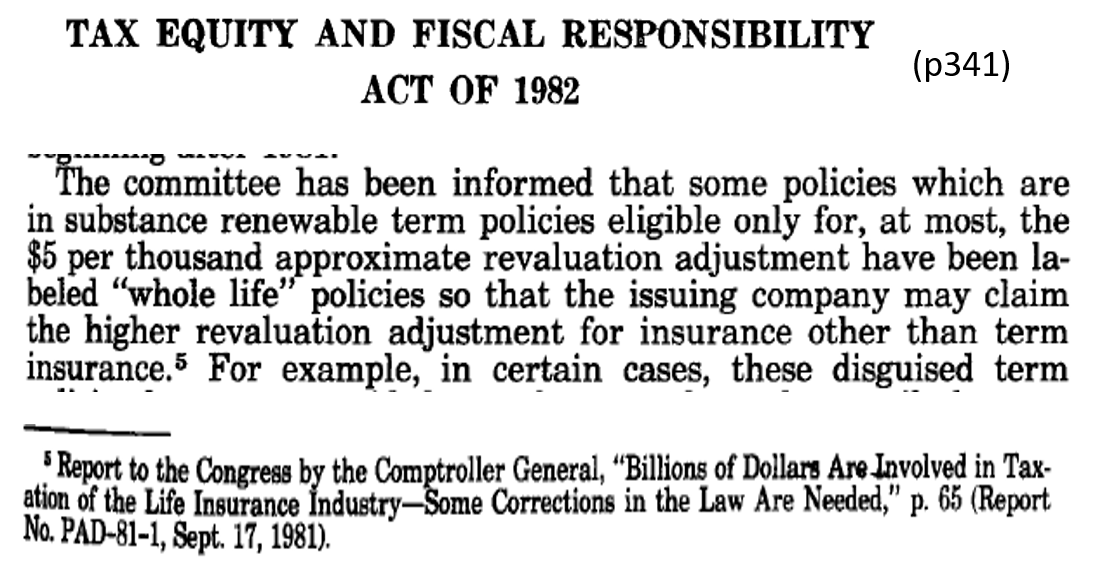
“The 818(c) election is another issue that is being looked at by the Service. In the Hutton ruling, the Service specifically took a caveat indicating that they were saying nothing with respect to this issue. One question that was discussed briefly was what was the plan of insurance? How do you know whether you have a permanent policy that qualifies for $21 per thousand, or a term policy that qualifies for $5, or perhaps some that qualifies for nothing. That is an unanswered question.” WILLIAM B. HARMAN, JR1981, Universal Life, Society of Actuaries
|
MR. DENNIS VAN MIEGHEN: Regarding 818(c), some companies are now starting to get in the audit cycle where their universal life products are being examined by the Internal Revenue Service (IRS). It’s not uncommon to have a 3-5 year delay on an audit, so there’s not a lot of experience to date. But we’ve had four or five companies that started issuing universal life in late 1979 and 1980 that have been subject to examination. It looks like there are going to be two attacks, and they are not consistent presently. One is that universal life represents term insurance and an annuity rider, and therefore, it’s not Life insurance. It doesn’t qualify for 818(c) because it’s not whole life; it’s term insurance with an annuity. This is a breakout approach, if you will. Another attack is that, at the agent level, the IRS is allowing 818(c), but it is disallowing the differential between the cash value reserve and that portion of the reserve that is set up in Exhibit 8A in the U.S. annual statement as a GRVM reserve. That varies by company as to whether the company tried to calculate a separate CRVM reserve and then show an excess cash value in Exhibit 8G. But in that approach, the IRS is essentially allowing 818(c) but disallowing the differential between CRVM and cash value saying it’s essentially a surplus reserve and not deductible. When we get through with all this, I think the IRS’s attack will focus on whether a product with a cash value reserve as the total reserve before segregation has a recognized preliminary term or CRVM reserving method. In any event, I think you will see an attack trying to allow $0 or $5 at most, and it will probably end up in court because the dollars involved are very large. RSA85V11318 |
financial incentive for holding CRVM rather than net level reserves.
1980, NONFORFEITURE AND VALUATION CONCERNS IN THE 1980’S, Society of Actuaries
Term productsor graded premium whole life products are using tax losses created by
electing the 818(c).