Maloof v John Hancock
Maloof v John Hancock
2010 – Maloof v John Hancock – Alabama Supreme Court Opinion – 39p
After receiving these notices, John contacted Glasgow <Agent>, who had retired in 2000, to inquire why his policies would be terminating, even though he had timely paid the premiums on the policies for approximately 18 years.
Maloof – PolicyownerGlasfow – Agent, and also Policyowner
…which allegedly deceptive sales practices used by Manulife between 1982 and 1993 were challenged; Glasgow <Agent> subsequently joined in that motion.
Maloof v. John Hancock Life Ins. Co.60 So. 3d 263 – Ala: Supreme Court, 2010 – Google Scholar “They later received
another notice from John Hancock, dated May 29, 2007,
informing them that an additional premium payment of $7,573.15
was required by July 29, 2007, in order to continue the 1989
universal-life policy until November 29, 2007; otherwise, this
notice informed them, that policy would terminate on July 29. After receiving these notices, John contacted Glasgow, who had
retired in 2000, to inquire why his policies would be
terminating, even though he had timely paid the premiums on
the policies for approximately 18 years. John states that
Glasgow told him that he would investigate the matter, and it
appears that Glasgow did subsequently contact John Hancock; however, John states that Glasgow ultimately told him that
there was nothing Glasgow could do.” “The gravamen of
their complaint was that Glasgow had misrepresented to them
….that the policies would provide
benefits that would be available to pay any estate taxes due
upon John’s death when, in fact, based upon the projected
insurance and interest rates at the time of sale, those
policies would likely lapse when John was approximately 78
years old unless the Maloofs at some point substantially
increased the amount of the premiums they paid.”
(20)
However, the Maloofs could not havereasonably relied on the alleged misrepresentations concerning
the availability of benefits from those policies to pay estate
taxes due upon John’s death in light of the clear language of
the insurance policies.
(21)
The Maloofs allege thatGlasgow agreed to procure life-insurance policies for them that would provide benefits available to pay estate taxes due upon John’s death; however, they argue, they now have no such life-insurance policies. The undisputed facts indicate that Glasgow did in fact procure two universal life-insurance policies for the Maloofs and that, had the Maloofs continued to pay sufficient premiums on those policies, they would have remained in effect and the benefits of those policies would have been available for any purpose after John died.
(22)
Thus, the undisputed facts indicate that Glasgow in fact fulfilled the Maloofs’ request to procure life-insurance policies that would provide funds that could be used to pay estate taxes upon John’s death, and those policieswere canceled only after the Maloofs failed to pay the required premiums. On April 16,
2008, John Hancock moved the trial court to stay all
proceedings pending a ruling from the United States District
Court for the Southern District of California on whether the
Maloofs’ action was barred by the settlement of a class action
overseen by that court in 1998 in which allegedly deceptive
sales practices used by Manulife between 1982 and 1993 were
challenged;
Glasgow subsequently joined in that motion.”
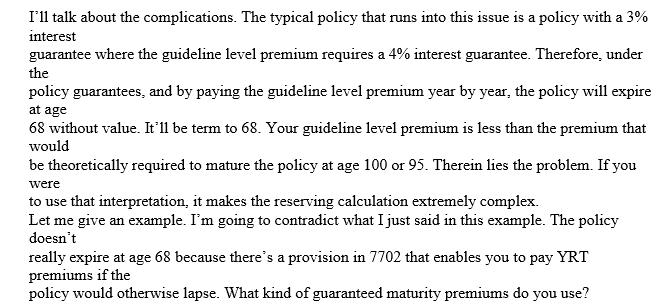
1999, Valuation Actuary Symposium – Session 44, Edward L. Robbins, Society of Actuaries