Cost Disclosure
Cost Disclosure
MR. JOHN K. BOOTH: Cost comparison and disclosure for individual life insurance has been discussed and debated for well over a decade.
Why is it that there are still divergent views on a subject that has received so much extended attention?
Certainly, it is not for lack of techniques or methods for comparing costs to the consumer.
Over the years, actuaries, academicians and others have proposed, analyzed, compared, studied, discarded, and reintroduced a variety of approaches to cost comparison.
Nor is it for lack of public debate on the subject inasmuch as it has been discussed in many hearings before the National Association of Insurance Commissioners (NAIC), state insurance departments, committees of state legislatures and committees of the U.S. Congress.
If the solution to the cost comparison and disclosure issue was merely one of finding the right method or technique for providing consumers with information to help compare policy costs, it would have been resolved long ago.
What makes the issue so difficult is that it directly impacts the ability of rival life insurance marketing forces to compete for the consumers’ dollar.
1981, INDIVIDUAL LIFE INSURANCE COST DISCLOSURE ISSUES, Society of Actuaries
“However, as we have stressed previously, at the time a life insurance policy is issued, the ‘true cost’ of a policy cannot be determined under any circumstances by any method.”1975-2 NAIC Proceeding “A review of the discussions in our Society’s meetings shows that little concern has been devoted to the consumer. I think that we should make cost disclosure simple and easy for consumers to understand by putting ourselves in their shoes and making them aware of the vast area of uncertainties in life insurance cost.” PAUL J. OVERBERG
1980, AN EXTENSION OF THE NAIC SYSTEM FOR LIFE INSURANCE COST COMPARISONS by CHARLES L. TROWBRIDGE, Society of Actuaries 1982-2 NAIC Proceeding
ATTACHMENT ONE
LIFE INSURANCE COST DISCLOSURE — HISTORICAL BACKGROUND
1992 STATEMENT BY SENATOR STROM THURMOND (R-S.C. ) BEFORE THE
SUBCOMMITTEE ON ANTITRUST, MONOPOLIES AND BUSINESS RIGHTS, SENATE
JUDICIARY REFERENCE HEARING ON CONSUMER DISCLOSURE OF
INSURANCE “It is not clear whether deliberate misrepresentations are
made in the sale Of these policies, Or whether consumers need to
be better educated about the product they are purchasing. In any
event, the hearing this morning will serve to educate us about
these issues, and to raise public awareness so that consumers
themselves will be more knowledgeable.”
1994-2 NAIC Proc. 974
At the Sept. 9, 1993, conference call of the actuarial task force, the members agreed that the actuarial task force will provide definitions needed relating to cost disclosure.
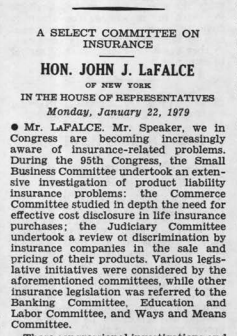
1981/2/16 – Newspaper – Iowa City Press-Citizen (Iowa City, Iowa)
1977 – Cost Disclosure in Individual Life Insurance – soa
MR. RUSSELL R. JENSEN: The purpose of disclosure is to let the life insurance buyer know what he’s getting. At its best it ought to be–and often is–a. EXECUTIVE (EX) COMMITTEE, 1973-2 NAIC.. Exhibit Il which shows that, in the last fifty years, no less than 21
different attempts have been made to solve this problem..
insurance departments. Furthermore, enacting a federal statute on life
insurance cost disclosure would only address itself to part of the
problem. References
1980, LIFE INSURANCE COST DISCLOSURE: A DECADE JUST COMPLETED, John P. Meyerholz, The Forum (Section of Insurance, Negligence and Compensation Law, American Bar Association), Vol. 15, No. 5 (Summer 1980), pp. 889-913
1979, SOA, Cost Disclosure, RSA79V5N45
1973-2 NAIC
STATEMENT OF STANLEY C. DUROSE, JR. (COMMISSIONER OF INSURANCE — WISCONSIN) ON BEHALF OF THE NATIONAL ASSOCIATION OF INSURANCE COMMISSIONERS BEFORE THE SUBCOMMITTEE ON ANTITRUST AND MONOPOLY LEGISLATION SENATE JUDICIARY COMMITTEE, LIFE INSURANCE COST AND BENEFIT COMPARISONS, February 21, 1973
On the face of it, the assignment of the Task Force to develop a better formula and format for cost comparisons looks like a simple one. But, as I shall show later in this statement, it is a very complex problem — one which has defied the best minds in the business and among the commissioners for many years. And finding the best way to make the comparative cost and benefit data available to the public for informational and comparative purposes presents some tricky problems centering around the proposition that producing the required simplicity can lead to results which may be both inaccurate and misleading. But, to summarize, the point I want to make at the outset is that cost disclosure has long been a tradition in the life insurance business. What the discussion today is about is not whether to disclose, but how to do it better.